Extremes
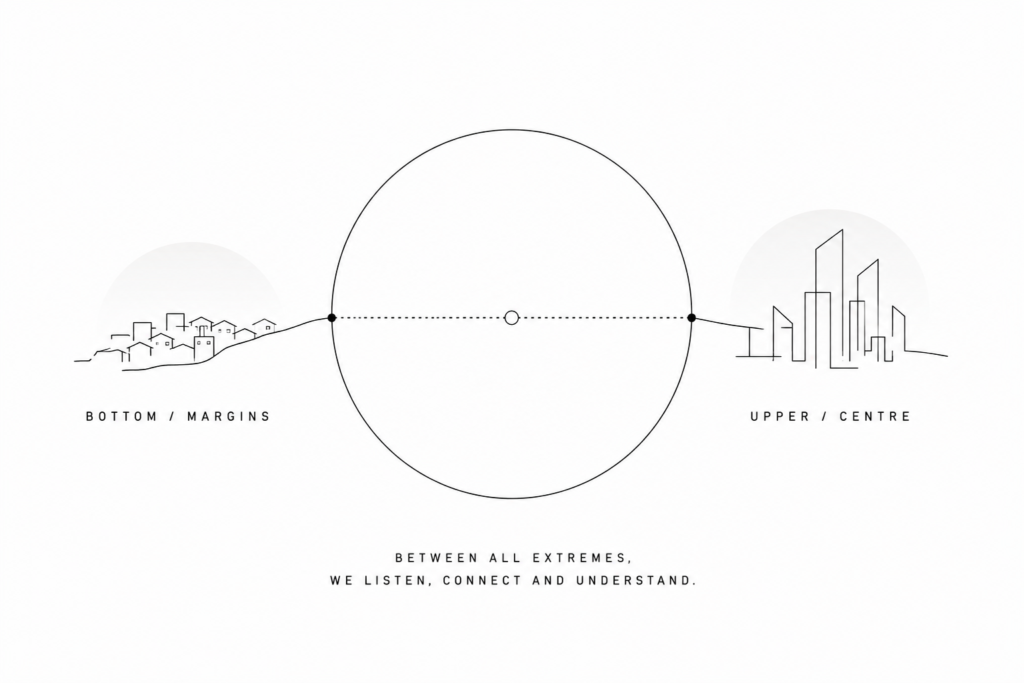
Extremes are not outside society. They reveal how society works.
SENSELAX studies the widest contrasts of social life: from the lowest and most exposed positions to the highest and most insulated, from scarcity to abundance, from exclusion to privilege, from enforced silence to overwhelming visibility. We use “extremes” carefully. The term does not describe strange people at the edge of a normal centre. It names conditions in which ordinary rules become unusually intense, visible or consequential.
THE FULL VERTICAL RANGE
Research on inequality often looks downward, toward deprivation, vulnerability and neglect. That work is essential, but incomplete if the upper reaches of power remain unexamined. Wealth, authority and status also have sensory and spatial conditions: quiet, distance, speed, security, controlled access, protection from inconvenience and the ability to set the atmosphere for others. To understand an extreme, we study the relations between exposure and insulation, waiting and acceleration, surveillance and privacy, service and command. The top and bottom of a system are not separate worlds; they are produced together.
MANY KINDS OF EXTREME
An extreme may be social, sensory, spatial, temporal, environmental or institutional. It can appear as chronic noise or absolute quiet; blinding light or dangerous darkness; hunger or saturation; crowding or isolation; permanent waiting or relentless urgency; public abandonment or total monitoring. It may emerge at a border, in a luxury enclave, on a platform, in a classroom, during disaster, inside a bureaucracy or within the routines of domestic life. These conditions often overlap, but they should not be collapsed into one scale of suffering or importance.
RELATIONS, NOT SPECTACLE
Extreme situations attract attention because they appear dramatic. That attention can easily become extractive: images are taken, stories are simplified, and communities are asked to perform their hardship for distant audiences. SENSELAX rejects this logic. We do not seek extremes for shock value or treat people as evidence of a theory. We ask how the condition was made, who benefits from it, how it is normalised, which forms of resistance already exist, and what obligations follow from learning about it.
CONTINUUMS AND THRESHOLDS
Most people move through gradients rather than fixed categories. A neighbourhood becomes unaffordable by degrees. A worker crosses from fatigue into danger. A public service shifts from inconvenient to inaccessible. A person moves between visibility as recognition and visibility as threat. We pay attention to these thresholds because they show when a difference becomes a division. They also reveal points where policy, design, education or collective action might interrupt an escalating pattern before it hardens. Thresholds are where prevention becomes possible and where apparently small design decisions can carry large social consequences.
CROSS-REGIONAL, NOT UNIVERSALISING
Across Europe, Africa and Asia, extremes are shaped by distinct histories as well as shared systems of finance, migration, extraction, technology, climate and governance. We compare without assuming that one region is the model and another the exception. Concepts and methods must be translated through local languages, knowledge and priorities. Sometimes the most useful outcome is not a global solution, but a precise understanding of why a practice belongs in one place and not another.
FROM EXPOSURE TO CHANGE
Studying extremes can produce maps of unequal access, sensory evidence for institutional reform, design principles for hostile environments, learning tools, counter-narratives, prototypes, policy questions or new alliances. Yet change begins with how the problem is framed. We ask not only how people can adapt to extreme conditions, but why those conditions are imposed, maintained or celebrated.
Conclusion
At the extremes, society becomes legible. SENSELAX works there to make hidden relations perceptible – and to turn perception into responsibility rather than spectacle.