DESIGN
Design begins after listening - and continues after launch.
For SENSELAX, design is not a decorative layer placed on completed research. It is a way of thinking through consequences. Design asks how an insight might alter a service, environment, interface, institution, learning process, public story or everyday practice. It gives ideas a form that can be encountered and challenged. It also exposes the assumptions hidden inside every proposed solution.
NO SOLUTION BEFORE THE QUESTION
Many innovation processes begin with a preferred product and search for a problem to justify it. We reverse that sequence. We start with experience, context and tension. Who is affected? What has already been tried? Which needs are spoken, and which are sensed but difficult to name? Who defines success? What should not be changed? A strong design brief is not a list of features. It is a shared account of the situation, its histories, conflicts, capacities and limits.
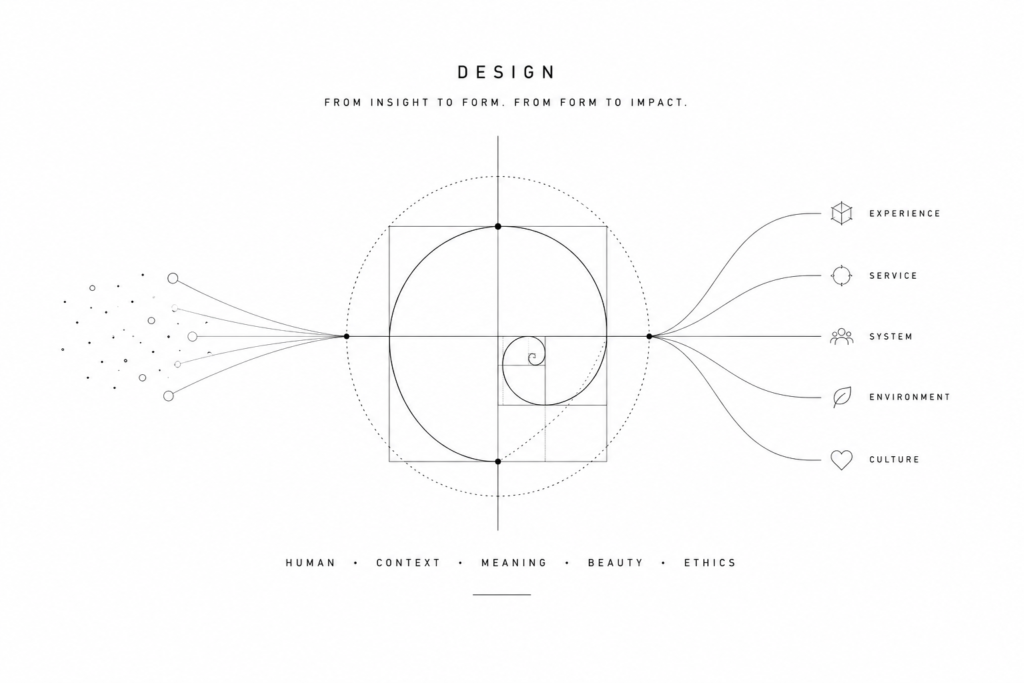
TRANSLATING RESEARCH INTO PROPOSITIONS
Humanities help us interpret meaning, memory, representation and values. Social sciences help us understand behaviour, institutions, networks and inequality. Design turns these readings into propositions that can be tested. An oral history may suggest a new wayfinding system. A study of waiting may reshape an appointment service. A sensory walk may reveal why a public square excludes certain users. An archive may generate a curriculum, identity system or speculative future. The translation remains traceable: people should be able to see how the design relates to the evidence and where imagination enters.
Beyond Objects
Beauty, coherence and emotional force matter. They can invite attention and create care. But aesthetics can also conceal extraction, make inequality appear natural or turn social pain into a marketable surface. Our design practice asks what a form does, who it represents, whose labour it hides and what behaviour it normalises. We seek work that is compelling without becoming manipulative, and clear without pretending complexity has disappeared.
The most appropriate design outcome is not always a product. It may be a protocol that changes how an institution listens, a learning tool that makes classification visible, a service that reduces humiliating procedures, an exhibition that returns an archive to public use, a policy scenario, a set of open prompts, a new role within an organisation or a decision not to introduce another system. We design across communications, services, environments, identities, curricula, platforms and organisational practices.
Conclusion
Evidence without imagination can reproduce the present. Imagination without evidence can float above reality. SENSELAX brings them together so that design becomes a responsible passage from what is sensed to what might be changed.
Note: The current website has undergone updates and improvements, with the latest update in August 2026.